v1.2.0 · Now Available
Orra Press
Multi-Module Serial Compressor
Seven dynamics engines. Six reorderable slots. One waveform at a time. Chain a Classic into a Spectral into a Clipper into a Limiter — or any combination you want.
Secure checkout by Lemon Squeezy
Seven engines, one window
Load engines into the six slots and reorder them with arrows. A fast FET into a slow Optical into a Limiter, or three Classics in a row each doing 2 dB. Every slot keys from its own source. Compare four arrangements with A / B / C / D and keep the one that wins.
The whole dynamics chain, built and reordered in one place.
The Six Slots
Each slot can hold any of the seven engines — duplicates allowed. Switching engines on a slot doesn't lose your dial-ins, so audition freely.
Try it — use the < > arrows to reorder the cards, just like reordering slots in the plugin.
Classic
VCA-Style
The workhorse. A feedforward VCA with stereo-linked peak detection, soft-knee static curve, and standard attack / release. Predictable, transparent, and dependable on busses, vocals, and second-stage glue.
Use it for
- •Drum bus glue
- •Vocal smoothing
- •Stage two of a chain
Optical
Opto-Style · Program-Dependent
An opto emulation that trades precision for feel. Dual-stage release — fast on isolated peaks, slow on sustained activity. Soft initial ratio that climbs as you push. Compress or Limit modes.
Use it for
- •Vocal leveling
- •Bass guitar
- •Two-bus glue with Limit mode
FET
Aggressive Grab · ALL Mode
Fast-attack FET-style with input-driven engagement. Push the INPUT knob to drive harder — the tanh saturation stage scales with gain reduction. ALL mode (all-buttons-in) hits past 20:1 with British-mode chaos.
Use it for
- •Drum room in parallel
- •Vocal peak control
- •Snare top transient grab
Multiband
4-Band Linear-Phase FIR
Four-band compressor with a linear-phase FIR crossover network. All bands share group delay — no cross-band bleed. Draggable crossover handles. Visual threshold lines per band on the spectrum.
Use it for
- •De-essing
- •Full-mix mastering glue
- •Kick / bass separation
Spectral
FFT-Domain Per-Bin
Frequency-domain compression on ~1000 independent FFT bins. The Resonance control targets narrow ringing peaks while letting broadband content pass through. Focus handles limit compression to a frequency range.
Use it for
- •Taming snare ring
- •De-harshing vocals
- •Killing room modes dynamically
Clipper
Peak Shaver · Near-Zero Latency
Not a compressor: no detector, no envelope, just a curve the signal cannot get past. Where a limiter pulls the waveform down around a peak, the Clipper shaves the tops off and leaves everything underneath untouched. Three shapes (Hard / Round / Warm), an adjustable knee, and anti-aliased oversampling at constant latency.
Use it for
- •Ahead of the Limiter on a master
- •Drum transient shaving
- •Parallel clip for density
Limiter
Mastering-Grade · True-Peak / LUFS
Brick-wall limiter with soft-clip pre-stage, lookahead, parallel fast/slow release, ISP prediction, and ITU-R BS.1770 true-peak detection. Three styles (Clean / Warm / Smash) and three quality tiers (4× / 8× / 16×).
Use it for
- •Final mastering brick-wall
- •Loudness boost on stems
- •Transparent peak control
How it works
Three simple steps that scale from a single track to a full master chain
Load
Each of the six slots has a dropdown that picks the engine: Empty, Classic, Optical, FET, Multiband, Spectral, or Limiter.
Switching engines on a slot doesn't overwrite your settings. Flip a slot from Classic to FET and back — your Classic dial-ins are still there.
Per-slot oversampling (Off / 2× / 4× / 8×) on every type, with the Limiter exposing 4× / 8× / 16× quality tiers for ISP-aware mastering.
Seven engines, ready in any slot
Reorder
Each slot card has < and > buttons that move it earlier or later in the signal chain. Reorder without losing parameters — settings travel with the slot.
Fast / aggressive engines before slow / gentle ones generally sounds cleaner. End the chain with the Limiter when you're ready to bring loudness up.
Multi-stage compression, small amounts of gain reduction at each stage, is a classic approach: try a 2:1 Classic into a 2:1 Classic, both at 2 dB. Same total reduction, half the artifact.
Order matters, and it is one click to change
Compare
Four full-plugin snapshots (A / B / C / D) live in the header. Each captures every slot's engine type, all parameters, the chain order, and sidechain routing.
Click A and dial in a setting. Click B and tweak. Each bank auto-remembers its own state, so switching between them is instant. RESET wipes the active bank; Opt / Alt-click a bank to copy the current state into it.
Snapshots persist with the project and with saved presets — ship a preset that includes four named variants of the same starting point.
Decide with your ears, not your memory
Sidechain anything, by name
Every slot has its own independent sidechain source. With Orra Link 2, the free companion sender bundled in the Orra Press installer, you pick those sources by track name instead of by channel number, so you can sidechain any track in any DAW, even where the host won't let you route across busses normally.
Six slots. Six independent sidechain sources.
Each slot's sidechain is configured independently: duck the bass on slot 1 with the kick, then have slot 3's compression react to a different track entirely. No bus juggling, no aux tracks.
Pick your sources by name
- AutoDrop Orra Link 2 on a track and it appears by name, tinted in the track's color, in every slot's sidechain picker. No channel to remember, no routing to document.
- ExternalThe host's dedicated stereo Sidechain bus. Whatever your DAW routes to the SC input drives detection: kick to bass ducking, the classic move.
- NumberedThe classic Link 1 to 36 channels are still supported for older setups and templates, right alongside the by-name Link 2 workflow.
Picks survive reloads. LISTEN and check.
Selections persist by track name, so your wiring is still there when you reopen the project. Hold LISTEN next to the picker to hear exactly what is keying a slot, and watch the source level meter to confirm the signal is arriving. If a named source disappears, the slot falls back to self-detection instead of keying off a stale channel, so audio always keeps flowing.
Multiband and Spectral aware
Multiband splits the sidechain through its own FIR crossover bank so each band's detector keys off the matching SC band, and a masking overlay shows a Link 2 source behind your spectrum in its track color. Spectral runs a parallel FFT on the sidechain, so you can carve spectral space in the main signal wherever the sidechain has energy. (The Limiter ignores sidechain by design; brick-wall limiters don't sidechain.)
Orra Link 2
Sidechain sender, bundled in the installer of every compatible Orra product
The all-in-one compressor
Workflow, visualization, and technical detail — every move in one window
Multiple of the same type
Nothing stops you from loading two Classics, two FETs, or three Opticals. Multi-stage compression, small amounts of GR at each stage, is the classic way to get control without an obvious squash.
Mix knob for parallel compression
Every engine has a Mix knob. Set it to 30–50% with an aggressive setting and you get parallel compression within a single instance — the classic "New York" drum trick without an auxiliary bus.
A / B / C / D snapshots
Four full-plugin states stored in the header. Snapshots persist with the project and with saved presets — ship a preset that includes four named variants of the same starting point.
Module and chain presets
14 factory chains in the header bank, each staging two to four modules with modest gain reduction per stage: vocals, drums, bass, mix bus, three mastering chains, and a broadcast voice. Every module also has its own preset system, with 35 factory module presets (five per type) built in. Set any as the default for new modules, and save your own with one click.
Per-slot oversampling
Off / 2× / 4× / 8× per slot for the detector and gain stage. The Limiter exposes Standard (4×) / High (8×) / Ultra (16×) for ISP-aware mastering with tighter true-peak control.
LIVE mode for tracking
A LIVE toggle drops the added latency on Classic / Optical / FET to zero for tracking and monitoring. Spectral and the Limiter keep their inherent latency and report it honestly. All latency is reported to the host via PDC, so your mix stays in time.
Orra Press in action
Seven engines, six reorderable slots, and the Orra Link sidechain system — see how it all comes together in a real session.
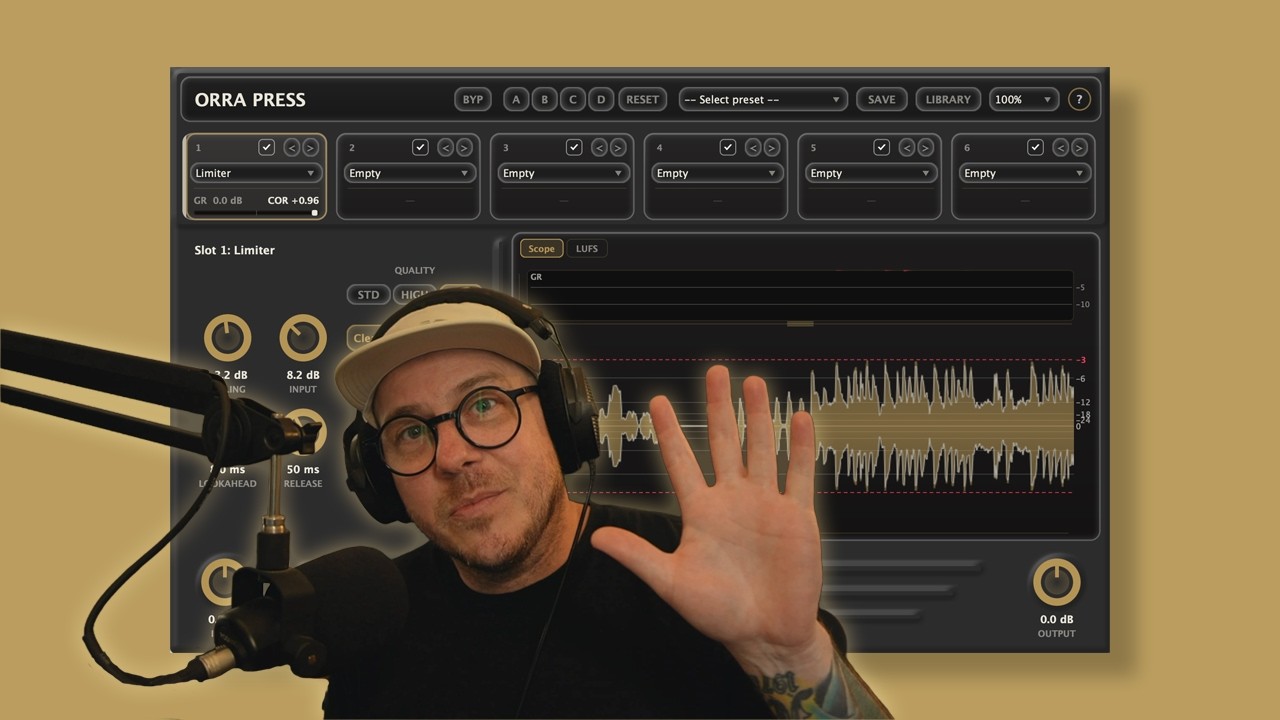
Seven Engines, One Waveform
Watch Orra Press in a real mix — chaining classics with multiband, dialing in spectral compression on a resonance, and using Orra Link to sidechain any track in the session.
More videos & articlesWhat's New in v1.2.0
Orra Press v1.2.0 adds a seventh module, per-slot solo, a sidechain high-pass, Spectral TILT and DELTA, AUTO gain and upward LIFT on Classic, alongside a round of fixes and optimizations. Everything is additive, so existing sessions and presets load unchanged.
Experience the difference
Try Orra Press risk-free with our full-featured 14-day demo. No credit card required.
Complete the family
Orra EQ
16 bands of parametric EQ with per-band dynamic saturation and 17 saturation algorithms — surgical sculpting that sits well in front of Press.
Explore Orra EQOrra Tone Zone
Free / pay-what-you-can. Tonal curve corrector with target curve system, adaptive auto-correction, and 6-band parametric EQ — a great place to start.
Try Tone Zone — Free