Rethinking EQ Boosts: Using Saturation for Musical Enhancement
The Problem with Traditional EQ Boosts
When you boost 3kHz by 6dB with a traditional parametric EQ, you're doing exactly what the numbers say: increasing the amplitude at that frequency by 6 decibels. It's clean, precise, and... often lifeless.
Traditional EQ Boost Limitations
- •They add volume, not character. You get louder at that frequency, but nothing changes about the harmonic content.
- •They emphasize what's already there. If the source lacks harmonic richness in that range, boosting won't create it.
- •They can sound harsh. Pure gain increases, especially in the upper midrange and highs, often feel aggressive rather than musical.
- •They lack dimension. The boost exists on a single frequency plane without the complexity that makes sounds feel “alive.”
Professional engineers know this. That's why they often reach for vintage gear, tube preamps, or tape machines when they want to “boost” frequencies—they're adding harmonic content, not just volume.
How Saturation Changes Everything
Saturation fundamentally alters the signal by generating new harmonic content. When you drive a signal into saturation, you're not just making it louder—you're creating new frequencies that weren't in the original source.
What Happens During Saturation:
- Harmonic generation: New overtones appear above and below the fundamental frequency
- Dynamic shaping: Transients get gently compressed while body gets enhanced
- Spectral richness: The frequency spectrum becomes denser and more complex
- Psychological loudness: The added harmonics make the signal feel fuller and more present, even at the same peak level
This is why saturated sources often sit better in a mix than cleanly boosted ones. The saturation creates harmonic “glue” that helps elements interact musically. It's not louder—it's richer.
Orra EQ's Approach: Integrated Saturation
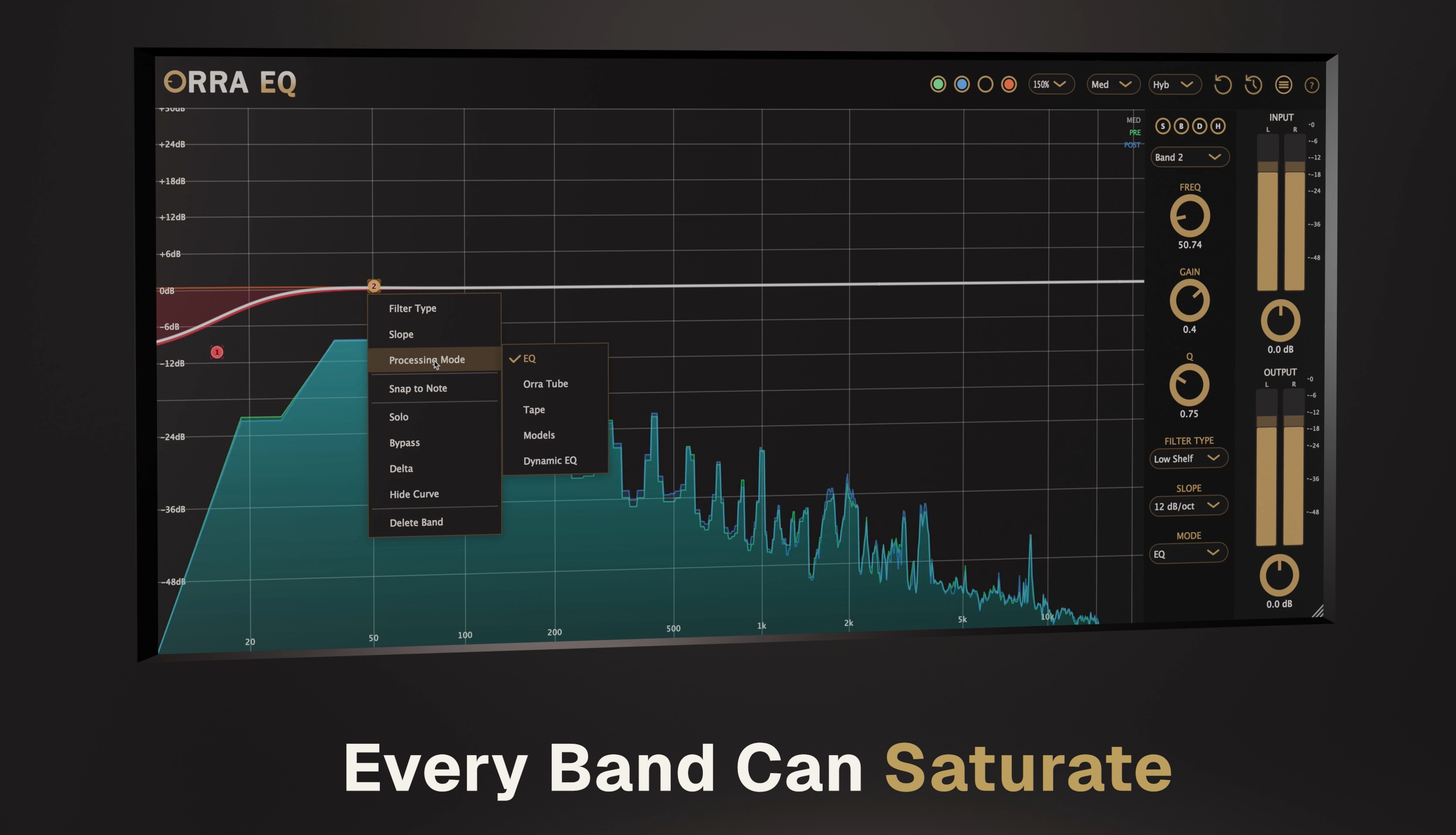
Orra EQ integrates three distinct saturation engines directly into each of its 16 bands, giving you precise frequency-specific harmonic control:
Orra Tube
The most versatile option for general-purpose harmonic enhancement. Adds warm, even-harmonic content without drawing attention to itself.
Tape
Six authentic tape machine models with different speeds and noise reduction settings (None, Light, Medium, Clean) for warm compression, gentle harmonic coloring, and that classic analog glue.
Models
Ten distinct saturation algorithms from subtle console coloration to aggressive harmonic distortion: VintagePreamp, PowerTube, Transistor, DiodeGermanium, DiodesSymmetric, Wavefolder, BitCrusher, BritishConsole, VCAConsole, Exciter.
The Double-Right-Click Workflow
Orra EQ includes a workflow shortcut that makes saturation-based tone shaping faster: double-right-click to create an Orra Tube band.
How It Works
- •Double-right-click anywhere on the frequency response curve
- •Orra EQ instantly creates a new band at that frequency set to Orra Tube mode
- •Adjust drive to taste
Note: Double left-click creates a standard EQ band. Double right-click creates an Orra Tube saturation band.
Series-Chain Architecture: Stacking Saturation Types
Orra EQ's series-chain design allows you to stack multiple saturation types for complex, evolving harmonic content. Because each band processes the output of the previous band, saturation stages interact and build on each other.
For example: Band 1 adds Orra Tube warmth, Band 2 adds Tape character to the already-saturated signal, Band 3 applies a Model to the accumulated harmonics. This cascading approach creates harmonic complexity that no single saturation stage could achieve.
Compare this to parallel processing (how most EQs work): each band would process the same clean input, missing all this interaction. The series chain is what makes Orra EQ's saturation integration truly powerful.
Saturation vs. Clean EQ
Both saturation and traditional EQ have their place. Clean EQ excels at surgical correction, maximum transparency, and predictable results. Saturation excels at adding character, harmonic richness, and musical complexity.
With Orra EQ, you can use both within the same plugin—clean cuts in some bands, saturated boosts in others—building exactly the tonal shape and harmonic character your material needs.