Dynamic Saturation: Adding Character to Your Mix
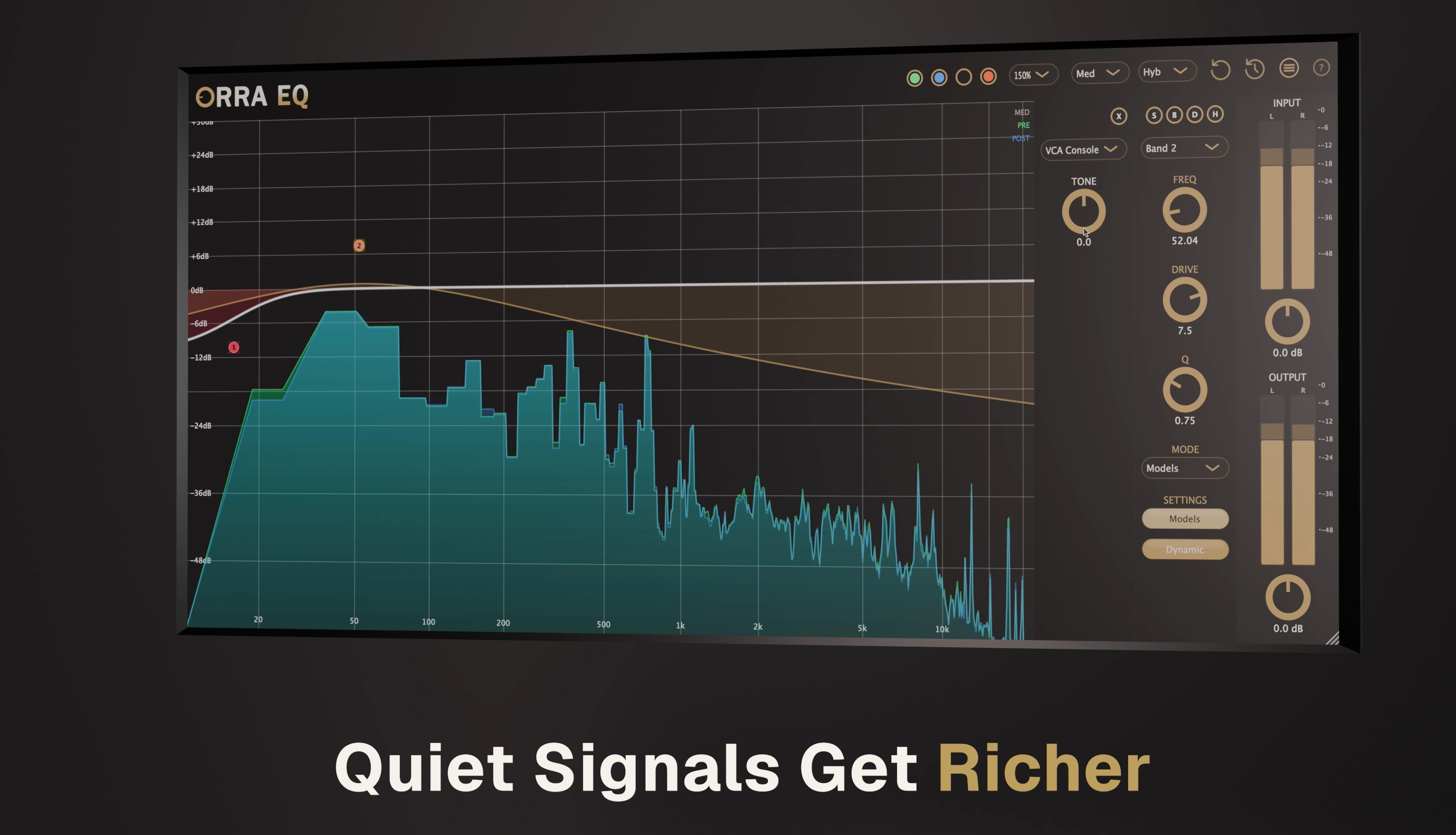
What is Dynamic Saturation?
Traditional saturation applies harmonics uniformly—loud signals and quiet signals get the same treatment. Dynamic saturation flips this on its head. It monitors your signal level and applies saturation only when the signal falls below a threshold.
Imagine upward compression, but instead of turning up the volume on quiet passages, you're adding warmth and harmonic density to them. The loud transients stay clean while the sustain and body get rich and full.
This creates a remarkably musical effect. Quiet details gain presence and weight without the pumping or squashing of traditional compression.
How It Works in Orra EQ
Every band in Orra EQ can operate in Dynamic mode, giving you frequency-specific dynamic saturation across 16 bands. When you enable Dynamic mode on a band, Orra EQ monitors the signal level at that frequency and applies saturation based on your threshold and drive settings.
What makes this powerful is the combination with Orra EQ's saturation models. You're not just getting generic harmonic content—you're getting the specific character of Orra Tube, Tape, or the custom Models applied dynamically to your signal.
Saturation Modes in Dynamic Context
- •Orra Tube: Adds warm, even-harmonic richness to quieter passages.
- •Tape: Imparts subtle compression characteristics alongside saturation.
- •Models: Access custom saturation curves for specific tonal shaping—from gentle warmth to aggressive bite.
Understanding the Controls
Dynamic saturation in Orra EQ uses four key parameters:
Threshold
Sets the level below which saturation engages. Higher thresholds mean more of the signal gets saturated; lower thresholds affect only the quietest parts.
Drive
Controls the intensity of saturation applied to signals below threshold. More drive equals more harmonic content and coloration.
Attack
How quickly the saturation responds when signal drops below threshold. Range: 1-100ms. Faster attack catches more transient tails; slower attack lets initial quieter moments through clean.
Release
How long saturation continues after signal rises above threshold. Range: 10-1000ms. Longer release creates smoother transitions; shorter release is more responsive.
Dynamic vs. Static Saturation
Static Saturation
Applies saturation uniformly to the entire signal regardless of level. Provides consistent coloration and harmonic character.
Dynamic Saturation
Applies saturation only to signals below the threshold. Preserves transients while enriching sustain and body. More responsive to the material's dynamics.
You can combine both approaches across different bands—static saturation on one frequency range, dynamic on another. That's the flexibility of having 16 bands to work with.